
Before the Next Storm
A field lesson from Kanokolus Beach — Tuesday, May 19, 2026
There's a moment in every good lesson when the abstract becomes real.
For a group of students from the Ecology Learning Center, that moment came on a gravel beach on the western shore of Lake Winnecook — knee-deep in burlap bags, cobblestones, and mulch, working to hold a shoreline together with their hands.
This wasn't a classroom exercise. It was the real thing.
Water Remembers Every Mistake We Make on Land
Rain falls. That part is simple. What happens next depends entirely on what the land looks like.
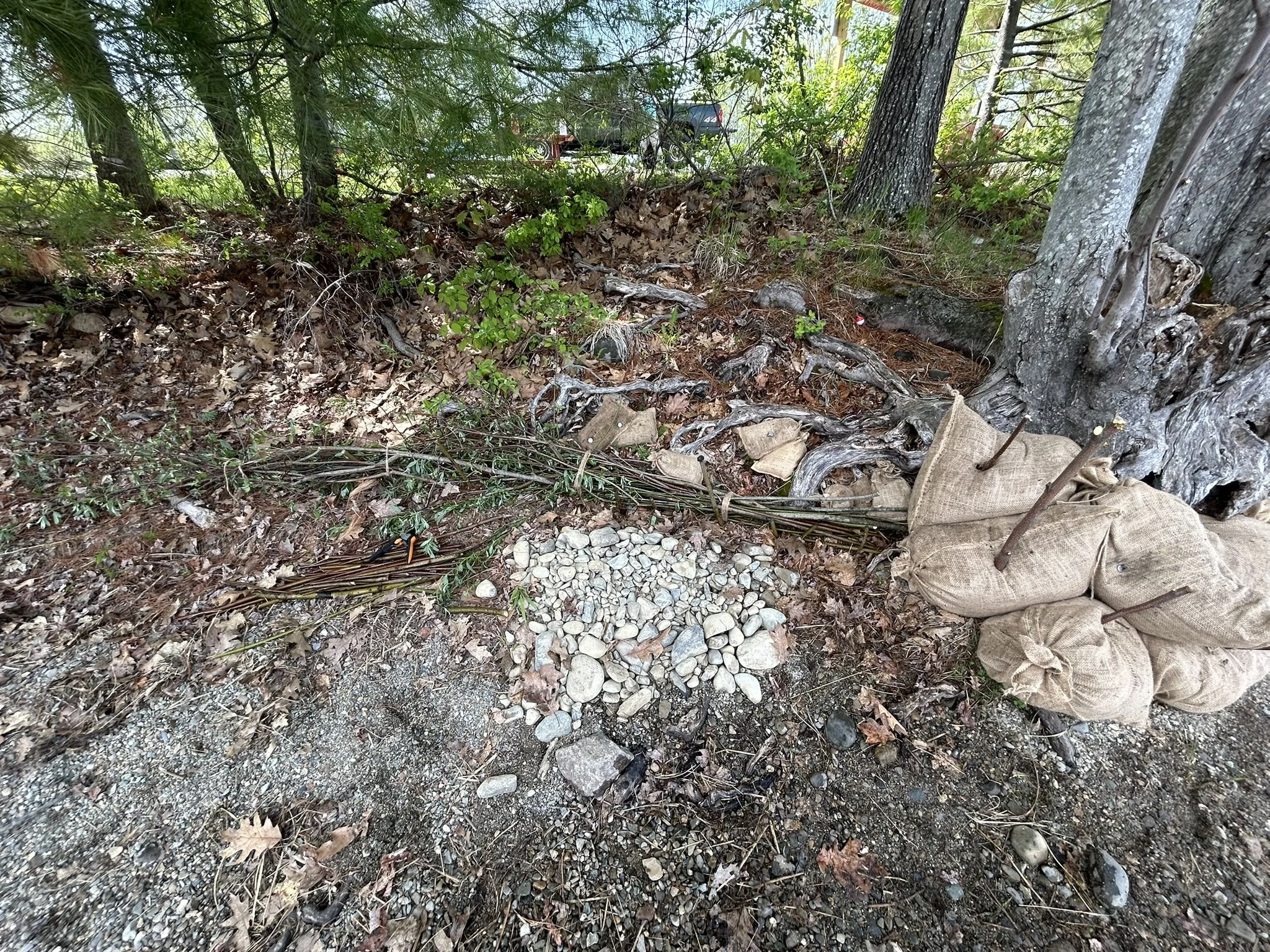
The eroding bank at Kanokolus — exposed roots, bare soil, and the tools ready to hold it together.
On a healthy, vegetated shoreline, rainwater slows down. Plant roots hold the soil in place. Water filters through layers of organic matter before it ever reaches the lake. What arrives is clean.
On a degraded shoreline — one with bare soil, eroded banks, and no root structure to speak of — rain becomes runoff. It moves fast, picks up sediment, nutrients, and pollutants along the way, and delivers them directly into the water. Every storm is a small disaster.
Kanokolus Beach had become that second kind of place. Years of heavy public use, wave action, and ice scour had left stretches of bare soil, exposed tree roots, and a bank that was slowly losing its fight with the water.
The lake was paying for it.
Nature Already Has the Answer — You Just Have to Work With It

Jordan Kimball (Maine DEP, Nonpoint Source Training Center) demonstrating the burlap bag technique to students from the Ecology Learning Center.
The solution wasn't concrete or riprap. It was plants, burlap, and willow. Here's what the students helped build:
Bundles of live willow branches staked along the eroding bank south of the boat launch. Willow is remarkable: stake a live branch into moist soil and it roots. Over the coming months, those four fascines will knit themselves into the bank, their root systems holding soil that nothing else was holding before.
Bags filled with cobble and erosion control mulch, staked in place around exposed tree roots. Simple, biodegradable, effective. They absorb wave energy and buy time for vegetation to establish — protecting roots that took decades to grow.
Not ornamental. Not random. Native species chosen because they belong here — whose roots are adapted to this soil, this climate, this lake. They'll stabilize the bank, slow stormwater, and filter runoff for years without anyone asking them to.
This approach has a name: living shoreline. It works with natural processes rather than against them. And unlike hard infrastructure, it gets stronger over time.
A Place Can Come Back
By Friday, what had been a high-impact erosion zone looked different. The bare soil was covered. The exposed roots were protected. The bank had structure where it had none before.
And something else had changed too.
Christian Arsenault, regular visitor to Kanokolus Beach
I used to take my chances riding down under the cable and needed help getting pushed back up.
Christian relies on a motorized wheelchair. The regraded access from the boat launch — level, clear, passable — meant he could reach the beach on his own for the first time. He and his wife Alexis joined Friends of Lake Winnecook that same week.
A restored shoreline. An accessible beach. A family newly invested in the lake's future. That's what a week of good work looks like.
What the Students Took Home

Ecology Learning Center students and volunteers installing native plants at Kanokolus Beach, with Lake Winnecook behind them.
The Statistics and Biology students from the Ecology Learning Center didn't just move mulch and fill bags — though they did plenty of that. They watched a watershed problem get addressed in real time. They learned why native plants matter, how erosion works, what a fascine is and why a live branch becomes a root system. They saw the connection between what happens on land and what ends up in the water.
Some lessons you can teach in a classroom. Some you can only learn on a gravel beach with a wheelbarrow and a purpose.
